THE DAYS OF ROSES MUSINGs ON A FIRST FULL LENGTH CREATION... MARY KATE CONNOLLY IN CONVERSATION WITH LUCA GIACOMO SCHULTE
DANCE THEATRE JOURNAL VOLUME 23 NO.4 2010
Photo: Rosa Frank
THE DAYS OF ROSES
Musings on a first full length creation...
Mary Kate Connolly in conversation with
Luca Giacomo Schulte
ln May 2009, Luca Giacomo Schulte, long-time dra-
maturg and artistic collaborator with Raimund
Hoghe, premiered Rosenzeit: Getanzte Lieder (1), a
solo work for the ltalian dancer Ornella Balestra, as
part of Tanz NRW 2009 (2). This is the first full length
work Schulte has created for theatre, and like Hoghe
before him (who worked initially for many years as
dramaturg to Pina Bausch before making his own
work), he is making a somewhat natural foray into the
world of creation and direction. Given that it is creat-
ed by Hoghe's long-time collaborator and a dancer
who performs regularly with him (3), it is understand-
able that on the surface, some links to his work can
be seen in Rosenzeit. Delving deeper however, the
work reveals a different complexion, erupting from a
different place, and with artistic devices particular to
Schulte.
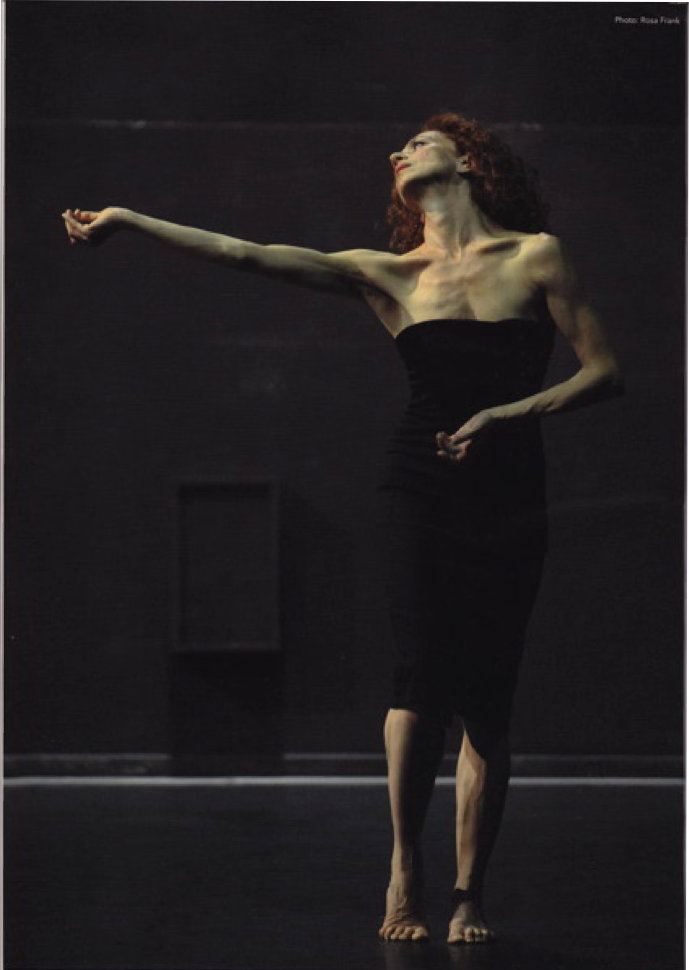
Formally, Rosenzeit offers a languid minimalist treatise
on gender, beauty, and the tracts of history which
caress Balestra's form, and the empty space which
surrounds her. Dressed in a plain strapless black dress
and impossibly high shoes, Balestra (re)traces an
evocative journey, through Lieder, French and ltalian
love songs, religious works and the music of Erik
Satie, with a reduced, highly stylised movement
vocabulary. Watching the work unfold it is unmistak-
ably evident that Rosenzeit was created for, and on,
Balestra - it quite simply would not work on another
body. ln the gloom, each and every sinew of her form
is heightened, softened by the cloud of flame red hair
tumbling about her shoulders. lt is a body strong and
wiry, frail and tiny; a body which easily acquires the
coquettish mantle of a girl in the first flushes of love,
but one which you know is older, forged by rigorous
training, memories and years. This feels essential for a
piece which, in a very oblique manner etches a cata-
logue of youth, disillusionment, abandonment and
self discovery; a woman looking back, re-inhabiting
the chisel blows that have formed her body... the
caresses and disappointments which have inscribed
themselves on her flesh. lt would prove an incongru-
ous fit for a younger form.
Visually, the work operates like an ever-evolving paint-
ing, with Balestra as the central figure in an otherwise
unadorned black landscape (a single crushed red vel-
vet cushion forms the only prop). The lines and per-
spectives forged by the movement in counterpoint
with the music serve to sever the emotion pent up in
the work from the physical actuality of Balestra. Thus
after a time, her physicality begins to operate on a
purely aesthetic level, until a turn in the music or
movement breathes emotional realism into the land-
scape and the viewer is thus jolted by the humanity of
her form. lt is on these levels that Schulte's back-
ground in fine art comes to the fore. Rosenzeit is cho-
reographed in brushstrokes, each sequence grounded
by a painterly sense of perspective and placing.
Mary Kate Connolly: How did this project come
about?
Luca Giacomo Schulte: The main impetus for
the project was Ornella. It all started during a
period when we did not have so much work with
Raimund and I thought it would be good to get
a choreographer to work with Ornella to keep
her a little bit busy! I asked Raimund and
Emmanuel [Eggermont](4) about a choreographer
and they said 'why not you?' I took a very natural
approach to the process and it unfolded from
there. Very early on, the idea came to me to link
her to a female character from the nineteenth
century, and I also at the time envisaged the
meeting of us in the creation of the piece as an
encounter between Germany and ltaly.
It brought to my mind the characters of the
Romantic period(5) because in Germany it was a
very strong period. During this time there was a
Ionging for the South, and a return to antiquity
and to the Romans. Here there was an important
link to ltaly, where the Renaissance ideas were
born. Romanticism was the era of Goethe and
also of Schubert and many German Art songs
were written. Initially following on from these
ideas, I thought a little bit about doing a work
comprised only of German Art songs but then I
also wanted to create a work ‘in situ‘ - I wanted
to work in response of the theatre and setting
where we were performing, in the Tanzhaus in
Düsseldorf.
The influence of German Romanticism can be seen to
underpin many of the facets of Rosenzeit. On a funda-
mental level, the exploration of individual liberty, and
nature as a source of inspiration (which characterised
the early Romantic era ‘Sturm und Drang‘) are evident
to the work (6). In addition to highlightning Balestra‘s indi-
viduality, evocations of nature echo throughout, earth-
ing her sometimes ethereal female figure. The hunting
cries of a bird of prey for example, water trickling in a
brook wich accompagnies a scene of cleansing and of
rebirth: in each of these Balestra appears to glean new
knowledge and strenght through a re-connection to
the natural world.
Arguably too, the counter-balance of opposites in
Rosenzeit which plays out not only in the visual bal-
ance of the piece, but in the gentle comment it pro-
vides on its subject matter, can be linked to the writing
and thinking of some contemporaries of the Romantic
era. Writing which for instance sought to envision a
harmony where all oposition and conflict would be
resolved by a unity. Hegel‘s posited interaction of
opposite ideas leading to a synthesis, or Schlegel‘s
philosophies on the concept of ‘irony‘, in which a form
of writing or thinking offered its own self-critique and
self-reflection, prove significant when considering the
threads which weave through Rosenzeit (7).
At the opening, Balestra lies prone in the semi dark-
ness. The shrill shriek of a hawk echoes, and slowly she
draws up to her full height and embarks on a coquet-
tish journey across the back cloth, statuesque and
commanding in her red-lined heels. All before her are
in her thrall, and yet so too is she imprisoned by her
seductive strength; it is tied to a necessity to conform,
to perform. She is an apparition, a vision of woman,
but a one-dimensional one. It is later as she removes
her shoes and stands barefoot, the trappings of seduc-
tion abandoned, that another facet is revealed. And so
this continues throughout - feminity and masculinity,
strength and weakness, death and rebirth - all are pre-
sented and immediately flipped like a coin to reveal
the opposing side of their reality. In these juxtaposi-
tions, concepts are immediately self-interrogative - no
sooner than the viewer has settled with the idea put
forward, than it has inverted to show an opposition.
And through this ever changing landscape, a sort of
harmony emerges - there is the sense of a deconstruc-
tion taking place within the work. A deconstruction of
woman and gender perhaps, but also of form, with the
resultant reassembly of each constituent part tinged
with a greater acceptance and balance.
Finally the dreamlike sense which seeps throughout
the work can be seen to have its roots in a Romantic
sensibility for intuitive modes of tought - an inclina-
tion towards the night-side as opposed to the day-
side of reality. Throughout Rosenzeit there is a perva-
sive dreamlike quality. It is unclear at times whether
Balestra is waking or sleeping, or perhaps retreating
into a subconscious reality rather than a present one.
In the same way as a painting studied for a prolonged
time will produce more and more facets, refusing on
an essential level to be ‘known‘, so too does this work
prevent complacency in the viewer.
MKC: Throughout the work, you seem to play
with gender and the opposing sides of strenght
and weakness. For example, the strenght and
inherent weakness in femaly sexuality. Could you
talk a little about that?
LGS: Well I think that you often find these
opposing elements in both the male and the
female. I felt that Ornella can be a little androgy-
nous looking, and we played with this a little in a
historical context with her hair for example - we
left her hair out loose because in fact that would
have been how a man in the Renaissance would
have worn it. Women wore their hair very close
to their heads and covering during that time, and
men wore theirs out open. In this way Ornella
reminds me a little of the intellectuals from the
Renaissance era, and so this for me evokes an
androgynous look. Also during the Renaissance
female artists, such as painters began to
emerge, and in both of these I think a strong
character is echoed.
Another reference to sexuality and opposing
forces is the hawk which shrieks at the begin-
ning. Ornella hates this reference because for
her it has a connotation of sexism, that in Italy
men consider women as little birds. But for me it
was not at all like this. For me it is more the
independence of a woman who is rising up and
who feels perhaps as free as a bird. It is also the
sound of a predator, a bird of attack, who is a bit
superior. And as Ornella rises up, for me it is the
rising up of individualism and of course more
specifically of a woman individual because she is
in her dress, and as soon as she stands up she is
immediately on her high heels. Here there is
perhaps for me also a reference to the
Renaissance and the rise of Humanism which
was bubbling up during that time.
And indeed even in the high heels there is still an ele-
ment of the androgynous: as she walks backwards
perhaps it could be a man in the high heels, it‘s not so
clear. In this way the character is a little like some of
female figures in Pedro Almodóvar movie -
androgynous or perhaps transgender. A little like
Carmen Maura in Law of Desire for example (8).
MKC: How was this process differed from your
work with Raimund - to go from artistic collabo-
rator to conceiving and creating a full piece?
LGS: Of course it was a change because as the
director of Rosenzeit I was fully responsible. But
this was very nice actually - I found it satisfying. I
was very calm throughout.
I thought beforhand that doing this piece
would alter the way I work - I was sure that after
the premiere in May that I would look at every-
thing differently, but now that it‘s done, I‘m not
so sure that I‘m any different! Initially I was
always wondering and worrying whether the
work would be too close to Raimund‘s work, but
after a time I got over that. Now that I have
done it, I feel that whilst it fits nicely alongside
the canon of Raimund‘s work, it also stands on
its own. Finally Ornella and I had a very good
working relationship and trusted one another,
which was really important. Actually it really was-
n‘t that scary!
MKC: Finally, religious imagery is quite strong in
the piece, could you talk a little about the influ-
ence of religion in the work?
LGS: Of course Ornella comes from a Catholic
country and her links to religion come from a dif-
ferent time and are quite conflicted. In the work I
sought to express this without being too theo-
retical. I tried to forge connections through the
music in which the connection is perhaps not
immediately obvious. For example one of the
songs, ‘Albergo a Ore‘ by Herbert Pagani, is an
Italian song which tells the story of two young
lovers who check into a pay per hour hotel to kill
themselves, and the song mentions how they
look like the saints in old paintings. Later there is
‘Agonie au Jardin‘ (9) which tells of the agony in
the garden while Jesus and his apostles maintain
their vigil before the crucifixion. Some moments
such as this are charged, but hopefully it is felt
more intuitively, rather than pointing it out so
obviously that it is embarassing. The religion is
partly a dramatic device but more significantly
the songs themselves are beautiful and there is
always an element of consolation or hope.
This sense of hope and consolation trickles through
Rosenzeit. It seems of particular pertinence to Schulte
in this, his first creation. Speaking about the final scene,
he says, ‘the last song ‘Mein schöner Stern‘ tells that the
stars should raise a person up to the sky, from the dust
of the earth. There is partly a death in this scene, but it
could also be a moment of catharsis, of coming through
something...that finally you see things clearer‘.
Mary Kate Connolly is a freelance artist and movement practioner.
Notes
(1) Trans: ‘The Days of Roses: Danced song‘ ‘Rosenzeit‘ is a ref-
erence to the song ‘Agnes‘ by Johannes Brahms
(2) Dance festival featuring work from across North Rhine
Westphalia, founded in 2007. www.tanz.nrw.aktuell.de
(3) Balestra has performed in Tanzgeschichten (2003), and
continues to perform with Hoghe in works such as Swan
Lake and Boléro Variations
(4) Emmanuel Eggermont is a dancer who performs in Raimund
Hoghe‘s work such as Boléro Variations, and the solo
L‘Après-midi.
(5) Schulte is referring to the German Romantic period,
specifically the eighteenth and nineteenth centuries.
(6) German: ‘Storm and Stress‘: German literary movement of
the late eighteenth century that exalted nature, feeling and
human individualism. Hinze, Klaus-Peter and Leonard M.
Trawick trans. (1993) An Anthology of German literature of
the Romantic era and age of Goethe, San Francisco: EM
Text
(7) Alford, Stephen E. (1984) Irony and the logic of the Romantic
imagination, New York: P. Lang. Honour, Hugh (1879)
Romanticism, UK and USA: Penguin. Williams, Howard LI,
(1989) Hegel, Heraclitus and Marx‘s Dialectic, Harvester
Wheatsheaf
(8) A 1987 fim by the Spanish director Pedro Almodóvar, star-
ring Carmen Maura, Antonio Banderas and Eusebio Poncela.
(9) From ‘Miroir de Peine‘ composed by Hendrik Andriessen,
lyrics by Henri Ghéon
Text and photograph are published on the pages 43-46 in the
volume 23, no. 4 2010
of the
Dance Theatre Journal
Laban
Creekside
London SE8 3DZ
United Kingdom
www.myspace.com/dancetheatrejournal
